
Click below to listen to my Garden Bite podcast:
My neighbor and I frequently walk in the woods along our nearby river. We like to go “off roading” and skip pavement, generally there are some bicycle trails we can find … or not… Basically we wander…
We were noticing a number of trees with small multiple bumps growing up from the trunk and continuing up the tree almost like steps.
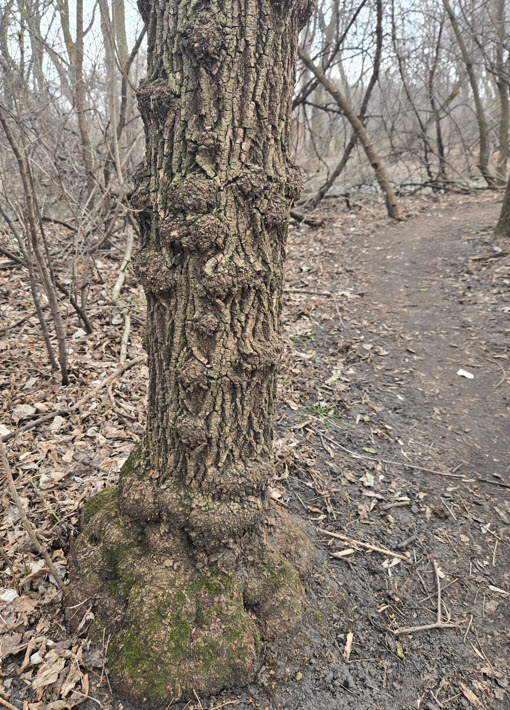
I’ve seen singular large bumps called burls and LOVE the look of them. What I didn’t realize was many could form on a single tree and also be so much smaller. I needed to do some research!!
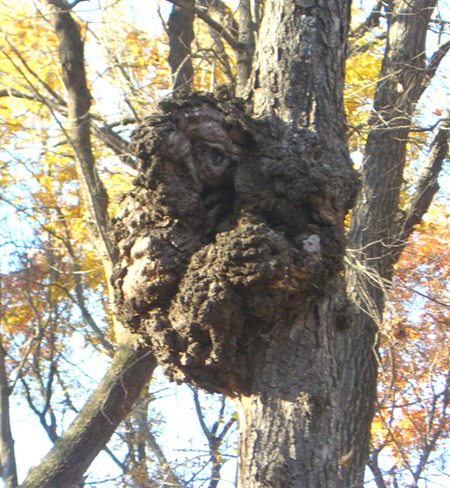
I went to northernwoodlands.org to learn more. The man behind the article is Joe Rankin, a woodturner. The burls are formed as a tree’s growth hormones get disrupted when the metabolism of the tree is hijacked by some other organism such as a virus, fungus or bacterium.
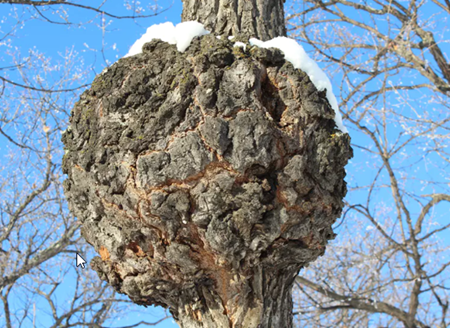
Physiologist, Kevin Smith, further explains that the cambium can also get stimulated by an insect and in response, the cambium divides more rapidly and irregularly and the burl (or tumor) forms. The cambium cell layer is the growing part of the trunk. It annually produces new bark and new wood in response to hormones that pass down through the phloem with food from the leaves. These hormones, called “auxins”, stimulate growth in cells. The U.S. Forest Service explains that Auxins are produced by leaf buds at the ends of branches as soon as they start growing in spring.
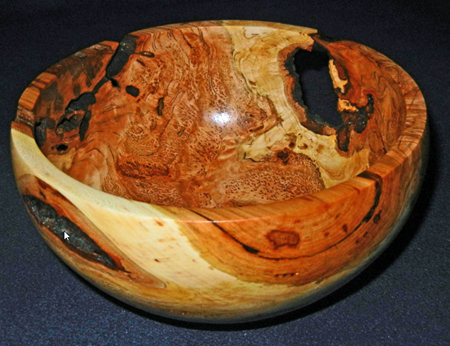
Burls are beautiful inside with color and texture and the large ones are prized by woodturners.
What’s really amazing is that burls don’t seem to do much harm to the tree OR shorten it’s life. The xylem, which carries water and nutrients from the roots up through the tree, is still able to do it’s job in spite of the burl.
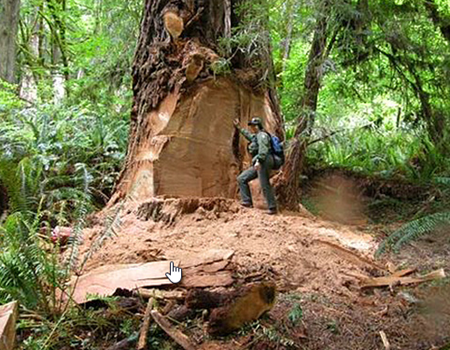
Cutting out burls, however, does damage a tree, since it leaves large wounds that are likely to become infected. It’s also illegal.
I reported on this over a decade ago and it is STILL a major issue. Ancient redwoods in National Parks in Western United States have been poached by thieves for their burls, including at Redwood National and State Parks. redwoodburlpoaching
The next time you’re out “off-roading” in the woods and find a burl just imagine the beauty within it! And leave it be….